
Ohio’s AAAs Show How a Coordinated AAA Network Can Strengthen Integrated Care

Area Agencies on Aging (AAAs) can make integrated care models for people who are dually eligible for Medicare and Medicaid more effective when states engage them early, clearly define their roles, and support them as a coordinated network. A white paper from the Ohio Association of Area Agencies on Aging (o4a) and Aurrera Health Group, From Local Expertise to Statewide Implementation: How Ohio’s AAA Network Supports Integrated Care, examines lessons from Ohio’s experience. We also produced a one-page executive summary of the report.
AAAs strengthen integrated care by connecting managed care systems with the realities of community-based service delivery. Their expertise in home- and community-based services, long-term services and supports, local provider networks, member and caregiver needs, and person-centered coordination can help states and managed care organizations design programs that better serve individuals. While financing arrangements and care management structures are important, they cannot replicate the local knowledge and trusted relationships AAAs bring.
Ohio provides a practical example of how states can embed this expertise into an integrated care model. When MyCare Ohio, the state’s Financial Alignment Initiative demonstration, launched in 29 counties in 2014, the state required participating Medicare-Medicaid Plans to contract with the seven AAAs serving demonstration counties to provide waiver service coordination for members age 60 and older. This requirement positioned AAAs as core program partners. However, variations in contracts, roles, data systems, documentation requirements, and workflows across health plans also demonstrated the need for greater consistency and earlier implementation support.
Ohio applied these lessons while preparing for the 2026 transition to Next Generation MyCare. With support from o4a, AAAs worked together to develop a single statement of work for use between all agencies and participating Next Generation MyCare managed care organizations. AAAs also collaborated with the state and health plans to develop a standardized statewide data exchange platform that reduces the burden of working across multiple plan-specific systems. In addition, the Ohio Department of Medicaid (ODM) invested in technical assistance and readiness planning before implementation, reinforcing the role of AAAs as crucial implementation partners rather than downstream contractors.
The white paper identifies three key elements of Ohio’s approach:
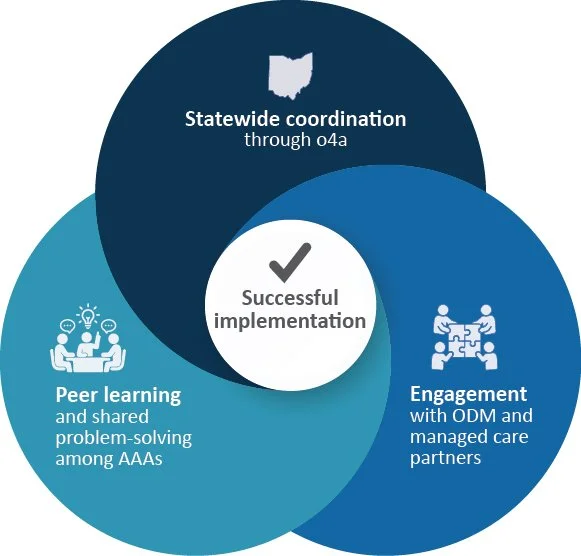
Statewide coordination through o4a
Engagement with ODM and managed care partners
Peer learning and shared problem-solving among AAAs
Together, these strategies helped individual AAAs turn their experience into stronger statewide readiness and more consistent implementation.
The implication for states and managed care organizations is clear: They should treat AAAs as strategic partners. By engaging AAAs early, establishing clear and consistent responsibilities, investing in technical assistance, and supporting network-level coordination, states and managed care organizations can better connect managed care infrastructure with local providers, community services, and the people they are intended to serve.
Aurrera Health Group was proud to partner with the Ohio Association of Area Agencies on Aging and Ohio's AAAs during the transition to Next Generation MyCare. If your state, aging network, or organization is planning a similar transition and would like to discuss how we can support your efforts please contact Kristal Vardaman.
Authors
![Caitlin Crowley [Deputy Director]](https://images.squarespace-cdn.com/content/v1/66902b12f1fed363b0b53399/1749578488700-MZZBPM7D5LL40FO1EUB5/Caitlin+Crowley.jpg)
![Sasha Hulsey [Deputy Director]](https://images.squarespace-cdn.com/content/v1/66902b12f1fed363b0b53399/1749582232436-7OTMWV8PN63B8ALSOK0V/Sasha+Hulsey.jpg)
![Kristal Vardaman [Managing Principal]](https://images.squarespace-cdn.com/content/v1/66902b12f1fed363b0b53399/1749580093593-C8BI0BAWRM66131D3K5Z/Kristal+Vardaman.jpg)