
Verifying Medicaid Work Requirements Without Creating More Paperwork
Under H.R.1, states must determine whether certain Medicaid applicants and enrollees satisfy work and community engagement (CE) requirements or qualify for an exclusion or exception. The Centers for Medicare & Medicaid Services (CMS) CE regulations establish how states must verify exclusions and exemptions. For an overview of the broader policy, see Aurrera Health’s overview of federal Medicaid work requirements.
How states design verification processes will directly affect members’ benefits, eligibility workers’ processes, and state administrative costs. Completing as much verification as possible without member engagement, using each data source only for decisions it can reliably support, and asking members for focused information only when necessary, can streamline and simplify processes for all involved.
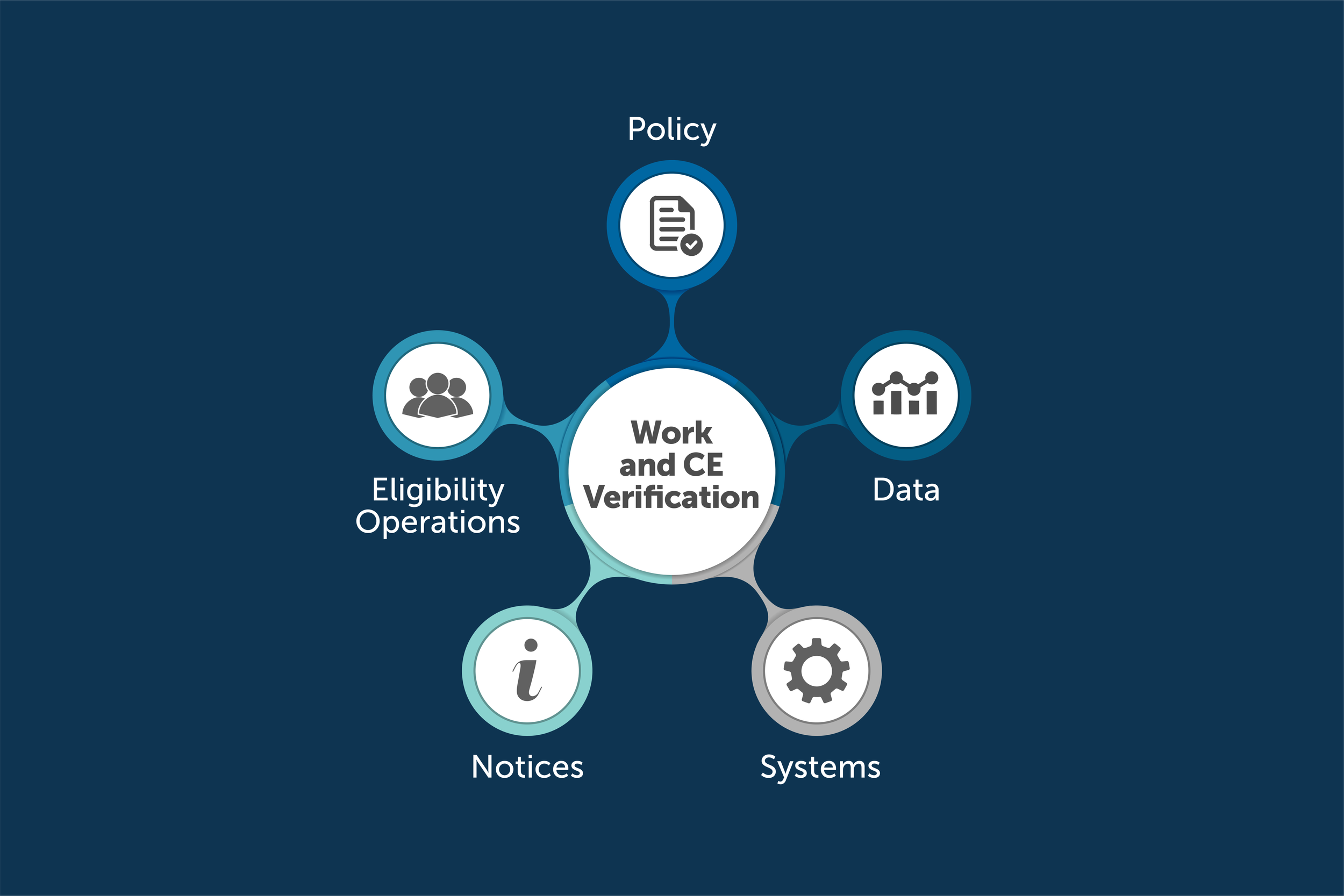
States need a verification operating model that connects policy, data, systems, notices, and eligibility operations. A set of data matches alone is not sufficient: each match must be tied to clear business rules, a defined response when information is incomplete or inconsistent, and an accessible pathway for members whose circumstances are not captured in data.
Build a “Check First, Ask Second” Workflow
The regulations require states to use all reliable information available to them before requesting additional information from an applicant or enrollee. States must first attempt to verify whether the individual is excluded from the requirement. If no exclusion is verified, the state must then determine whether the individual completed a qualifying activity or is deemed compliant through a mandatory or state-elected exception. Only after those checks are unsuccessful may the state seek additional information or begin the noncompliance process.
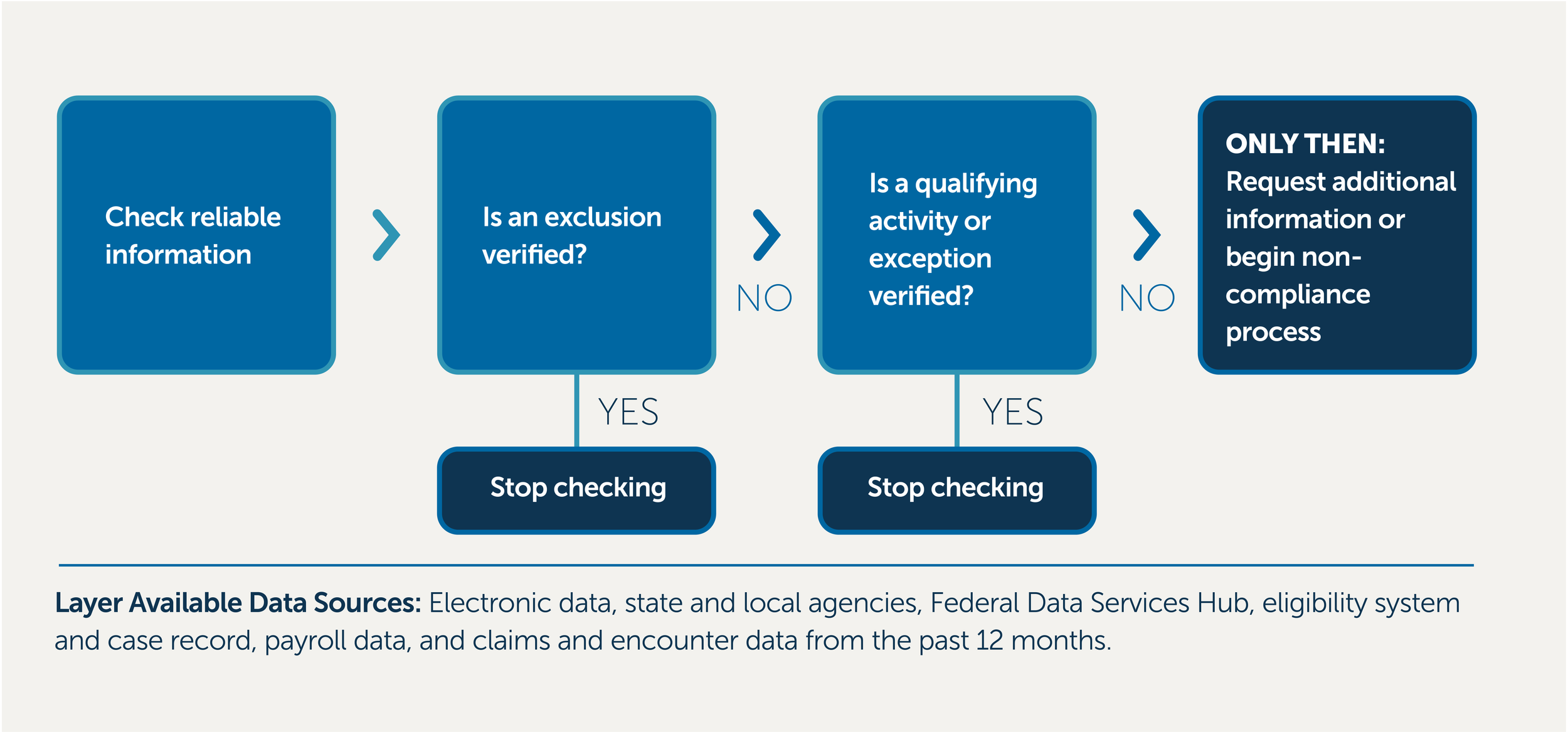
Reliable information may come from electronic data sources, other state or local agencies, federal sources available through the Federal Data Services Hub, the eligibility system and case record, payroll data, and relevant adjudicated claims and encounter data from the preceding 12 months. The process may be automated or may require a worker to retrieve information manually. What matters is that the state has a repeatable process for checking data sources before shifting the verification burden to the member.
Because no single source will capture every qualifying activity, exception, or exclusion, states should layer data sources within one coordinated workflow. The system should stop once it verifies an exclusion, compliance, or deemed compliance, while routing incomplete or conflicting results to the appropriate next step. This approach can reduce unnecessary requests without requiring every data source to answer every eligibility question.
Design Data Matches That Support Decisions
Connecting to a data source is only the first step. States should create a source-by-source verification framework that identifies the population and policy question each source can verify, how frequently the information is updated, what limitations or lags may affect the result, how conflicting information will be resolved, when a case must be routed for review, and what evidence must be retained for audit and oversight. Embedding these rules in system logic turns verification into a consistent workflow rather than a case-by-case interpretation.
For example, wage records may confirm that earned income meets the applicable income threshold even when hours are not reported. SNAP data may establish that an individual is in a household receiving SNAP and is not exempt from SNAP work requirements, supporting compliance. Education and workforce records may verify enrollment or participation. Claims and encounter data may support certain medical exclusions or short-term hardship exceptions, but a diagnosis code does not always establish the functional effect of a condition. For a closer look at that distinction, see Aurrera Health’s post on identifying medically frail individuals.
A well-designed match should verify only the eligibility factor that the data can reliably establish. States should avoid using partial information to draw conclusions that the source does not support. Clear rules about what each data source can verify can help states document automated decisions consistently and identify when additional review or information from the member is needed.
Make the Member Pathway Simple
Administrative data will not support verification for everyone. Some individuals will have new, informal, seasonal, or self-employment income; participate in community service or education that is not reflected in state systems; or qualify for an exclusion or exception based on circumstances that require additional context.
When member input is needed, states should provide one clear pathway for submitting information online, by phone, by mail, or in person. States can support this process by sending a short, state-designed form tailored to the specific information that could not be verified and prepopulated with information already available to the state. The form can identify the remaining questions and, when confirmation from another source is needed, include a section that an employer, school, volunteer organization, provider, or other appropriate entity can complete. This approach gives members a clear way to respond and helps the state collect the information needed for consistent eligibility decisions.
Targeted requests should also describe other acceptable documentation or information, explain how the information will be used, and state the response deadline and next steps. Under the CE regulations, the noncompliance process must give individuals 30 calendar days to make a satisfactory showing before eligibility is denied or terminated for noncompliance.
Importantly, the verification standard changes beginning January 1, 2028. Before that date, when reliable information is unavailable or not reasonably compatible with information provided by the individual, a state may require documentation or accept other sufficient information. Beginning in 2028, the state must require documentation whenever it is reasonably available and must accept other sufficient information when documentation is not reasonably available. States should clearly explain when the state-designed form is sufficient and when supporting or third-party documentation is required. They should also define acceptable documentation broadly enough to reflect the many ways people work, learn, volunteer, and experience qualifying circumstances, while helping individuals who face barriers to obtaining records.
Test, Monitor, and Improve the Process
Before implementation, states should test the complete verification process using realistic scenarios across qualifying activities, mandatory and optional exceptions, and excluded populations. Testing should include stale or conflicting data, newly reported circumstances, mixed-household cases, late-arriving files, manual review queues, and temporary data-source outages, not just the “happy path” where every match returns a clear result.
After launch, states should monitor the share of determinations completed using available data, the number of members asked for additional information, match and error rates by source, processing times, noncompliance notices, denials and disenrollments, appeals, and overturned decisions. Reviewing outcomes across demographic and geographic groups can also help states identify whether the process is operating consistently. These measures can reveal gaps in data coverage, business rules, notices, or workflows and support targeted improvements over time.
A successful verification strategy will connect reliable data with policy rules and a straightforward member pathway. States that build a check-first workflow, define what each source can establish, and plan for cases that cannot be resolved automatically will be better positioned to administer the federal requirements consistently while reducing avoidable paperwork and coverage loss.
For additional strategies to reduce preventable coverage loss, see Aurrera Health’s post on supporting Medicaid enrollees under community engagement and work requirements.
Looking Ahead
Aurrera Health helps states and their health care partners navigate complex policy environments through policy development, data and workflow design, operational planning, stakeholder engagement, and implementation support.
States and other stakeholders seeking tailored support with federally mandated Medicaid work requirements are encouraged to contact Lauren Block at lauren@aurrerahealth.com.
Author
